Vampire
Sunday, February 26, 2006
Georges-Louis Leclerc, Comte de Buffon
- For the town in Côte-d'Or, see Buffon, Côte-d'Or.
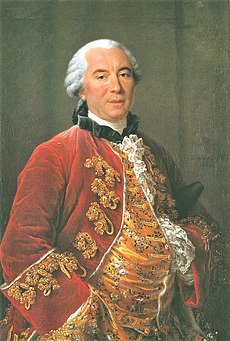
 Georges-Louis Leclerc, Comte de Buffon, by François-Hubert Drouais (1727-1775).
Georges-Louis Leclerc, Comte de Buffon (September 7, 1707 – April 16, 1788) was a French naturalist, mathematician, biologist, cosmologist and author. Buffon's views influenced the next two generations of naturalists, including Jean-Baptiste Lamarck and Charles Darwin.
Buffon's legacy is as direct and powerful as that of his monarch, Louis XVI. Buffon is best remembered for his great work Histoire naturelle, générale et particulière (1749-1788: in 36 volumes, 8 additional volumes published after his death by Lacépède). It included everything known about the natural world up until that date. In it Buffon considered the similarities between humans and apes, and the possibility of a common ancestry. Those who assisted him in the production of this great work included Louis-Jean-Marie Daubenton. Buffon's work is considered to have greatly influenced modern ecology (see history of ecology). His Histoire was translated into many different languages, making him the most widely read scientific author of the day, equalling Rousseau or Voltaire.1
The problem of Buffon's needle in probability theory is named in his honor.
In Les époques de la nature (1778) Buffon discussed the origins of the solar system, speculating that the planets had been created by comets colliding with the sun. He also suggested that the age of the earth was much greater than the 6,000 years proclaimed by the church. Based on the cooling rate of iron, he calculated that the age of the earth was 75,000 years. For this he was condemned by the Catholic Church in France and his books were burned. Buffon also denied that Noah's flood ever occurred and observed that some animals retain parts that are vestigial and no longer useful, suggesting that they have evolved rather than having been spontaneously generated.2 Despite this, Buffon insisted that he was not an atheist.3
Besides his many brilliant insights he is also known for expounding the theory that nature in the New World was inferior to that of Eurasia. He argued that the Americas were lacking in large and powerful creatures, and that even the people were far less virile than their European counter parts. He ascribed this to the marsh odours and dense forests of the continent.
He was born at Montbard, Côte d'Or. His father, Benjamin Leclerc, was the Lord of Dijon and Montbard. He attended Jesuit College from the age of ten, and then Angers University. He began studying law, but soon began to concentrate on his twin interests of mathematics and science.
He was forced to leave university after becoming involved in a duel, and set off on a grand tour of Europe, returning when his father's remarriage threatened his inheritance.
He first made his mark in the field of mathematics and in Sur le jeu de franc-carreau introduced differential and integral calculus into probability theory. During this period he corresponded with the Swiss mathematician, Gabriel Cramer.
His translations of works by Isaac Newton and Stephen Hales' Vegetable staticks into French heightened his interest in biology.
He moved to Paris, making the acquaintance of Voltaire and other intellectuals. He joined the French Academy of Sciences at the age of 27. He was Keeper of the Jardin du Roi (later Jardin des Plantes) in Paris from 1739. During his period in charge he converted it from the King's garden to a research centre and museum, and the park was considerably enlarged, with the addition of many trees and plants from around the world.
Buffon was very skilled with words, earning him the nickname from mathematician Jean le Rond d' Alembert of "the great phrasemonger." Speaking of his many detractors, he said, "I shall keep absolute silence . . . and let their attacks fall upon themselves." He said that the horse was "man's most noble conquest." When delivering his Discours sur le style (“Discourse on Style”), he said, "Writing well consists of thinking, feeling and expressing well, of clarity of mind, soul and taste . . . The style is the man himself" ("Le style c'est l'homme même").4 He lent his affinity of words to the world of science and, among others, is credited with coining the term prehensile (from Latin prehensus).
He was created Comte de Buffon in 1773. He died in Paris 1788.
Wood tests
 Statue of Buffon in the Jardin des Plantes
Buffon performed one of the most comprehensive series of tests that had been undertaken at his time on the mechanical properties of wood. Included were a series of tests to compare the properties of small clear specimens with those of large members. After carefully testing more than 1,000 small specimens and being extremely careful to ensure that the specimens contained no knots or other defects, Buffon concluded that it was not possible to predict the properties of full-size timbers containing defects from tests of small specimens, and he began a series of tests on full-size structural members. His conclusion that tests of small specimens (without further adjustment) cannot be used to predict the properties of full-size members raised a question that was to continue into the 20th century.
Endnotes
- "Buffon, Georges Louis Leclerc, comte de," Encyclopedia of Life Sciences, Biographies Plus Illustrated (H.W. Wilson Company, 2001)<http://vnweb.hwwilsonweb.com/hww/login.jhtml> [Accessed December 26, 2005].
- "Buffon, Georges Louis Leclerc, comte de," Hutchinson Encyclopedia of Biography,, Biographies Plus Illustrated (H.W. Wilson Company, 2000) <http://vnweb.hwwilsonweb.com/hww/login.jhtml> [Accessed December 26, 2005].
- "Buffon, Georges-Louis Leclerc, count de," Encyclopædia Britannica, Encyclopædia Britannica Online <http://www.britannica.com/eb/article-9017945> [Accessed December 26, 2005].
- Ibid.
 Wikimedia Commons has media related to:Georges-Louis Leclerc, comte de Buffon
| Preceded by: Jean-Joseph Languet de Gergy | Seat 1 Académie française 1753-1788 | Succeeded by: Félix Vicq d'Azir |
Archives
September 2004 February 2005 February 2006 March 2006 July 2006
- Parent may refer to:Parenting, comprising all the ...
- Amazon Mechanical Turk
- Frédéric Bamvuginyumvira

